Case Study: Grupo Ramos Uses Ise AI to Generate and Remediate Product Images at Enterprise Scale
AI Product Image Generation & Compliance at Enterprise Scale
Context
Enterprise retailers increasingly depend on high-quality, compliant product images to operate and scale eCommerce platforms. For large catalogs, product image quality is not a creative preference—it is an operational requirement that directly affects SKU activation, category expansion, and digital merchandising velocity.
Grupo Ramos, the leading enterprise grocery retailer in the Dominican Republic, manages a large and diverse digital catalog spanning tens of thousands of SKUs. Over time, legacy product images accumulated across categories, creating misalignment with internal photography standards and introducing operational friction across category management, merchandising, and platform teams.
Vendor-supplied product images varied widely in quality and format and frequently failed to meet enterprise photography guidelines. Manual remediation cycles were slow. Vendor coordination was inconsistent. As a result, product image readiness increasingly became a gating factor for eCommerce growth, delaying PDP launches and category rollouts.
The Enterprise Challenge: Legacy Product Image Debt
Like many enterprise retailers and marketplaces, Grupo Ramos faced a structural problem:
Vendor-supplied product images were frequently non-compliant with enterprise photography guidelines
Intake teams spent disproportionate time rejecting, chasing, or manually fixing images
Image issues delayed SKU onboarding, vendor activation, and PDP readiness
Legacy image debt compounded over time, creating ongoing operational drag
In this environment, image compliance became an operational tax on growth—one that could not be resolved through incremental process improvements or additional manual review capacity.
Objective: Evaluating AI Product Image Generation and Remediation
The proof of concept was designed to test whether AI product image diagnosis, generation, and remediation could operate at enterprise-grade standards, not just produce visually acceptable images.
Specifically, Grupo Ramos evaluated Ise AI’s ability to:
Auto-diagnose product image non-compliance at scale, based on a detailed enterprise photography and compliance brief provided in Spanish
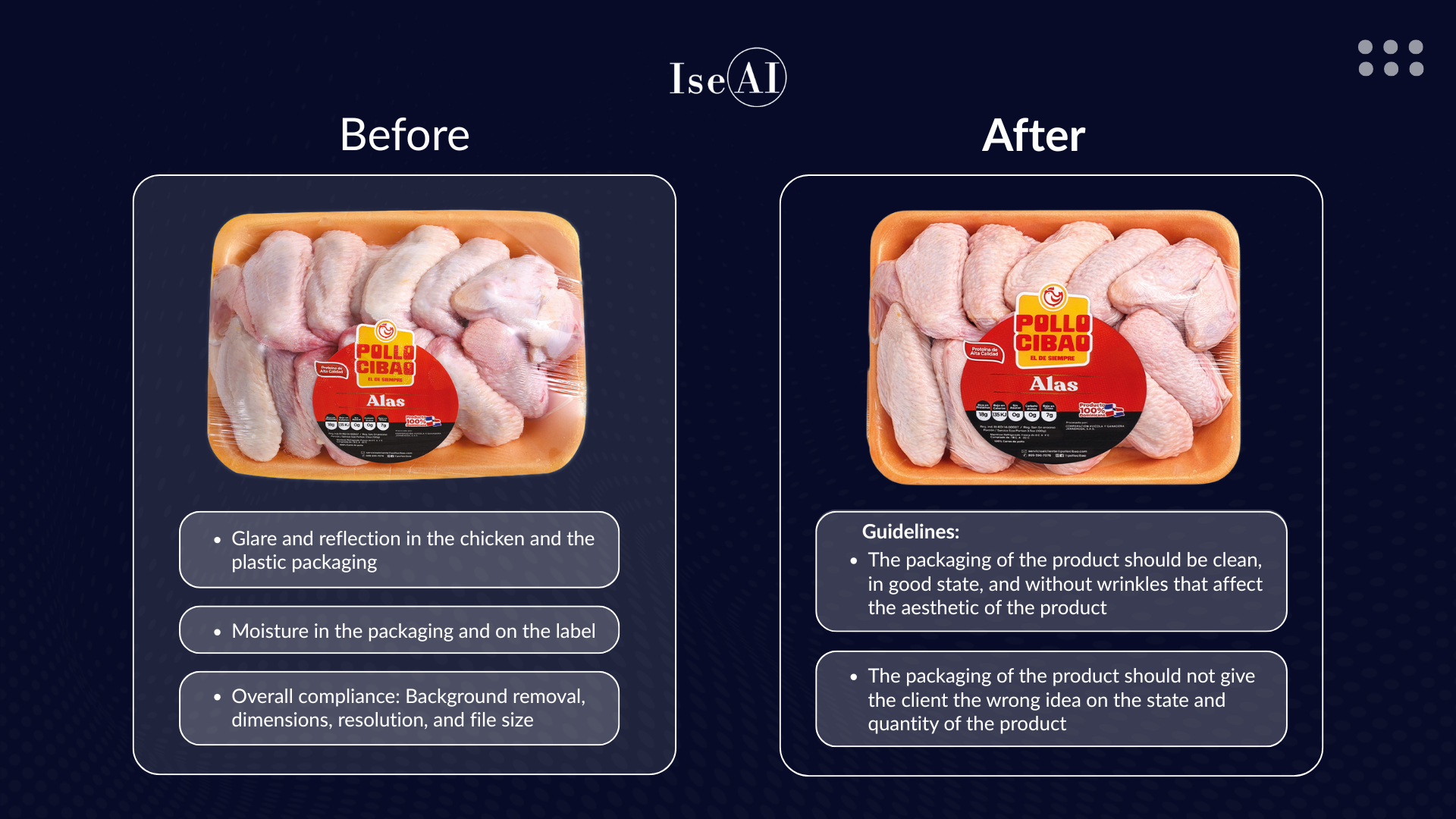
Generate and remediate product images using AI, correcting issues such as framing, background consistency, lighting, and presentation while preserving product fidelity
Enforce enterprise photography guidelines consistently across SKUs, vendors, and categories
Deliver compliant, production-ready product detail page (PDP) images fast enough to support cross-functional review and approval
Grupo Ramos evaluated whether AI could be used as a system of record for product image generation, correction, and compliance enforcement.
How Ise AI Works
Ise AI functions as a centralized AI system for product image generation, remediation, and compliance enforcement:
Ingesting Existing or Vendor-Supplied Product Images
Evaluating Images Against Enterprise Photography and Compliance Guidelines
Automatically Generating and Correcting Non-Compliant Images Using AI, without manual QA cycles
Outputting Production-Ready PDP Images at Scale
This approach replaces fragmented vendor workflows and manual remediation cycles with a single scalable system that enforces image quality at the source.
From Manual Bottleneck to Scalable System
The Ise AI workflow mirrored how category managers and eCommerce operations teams evaluate product image readiness—while eliminating months of repetitive manual work.
What would normally require:
Multiple vendor touchpoints
Iterative rejections and resubmissions
Manual fixes and subjective QA
Was replaced with a centralized AI-driven process.
The full proof-of-concept image set—covering approximately 31,000 SKUs—was reviewed, corrected, and validated in approximately one hour.
All stakeholders aligned in a single live session, enabling immediate approval to scale the solution across the full catalog without slowing ongoing platform initiatives.
Impact for Grupo Ramos
By resolving product image compliance at scale, Grupo Ramos removed a persistent operational constraint on eCommerce execution.
PDP images were remediated rapidly
Category rollouts were unblocked
SKU onboarding velocity improved
Digital merchandising teams could execute without recurring image-related delays
Most importantly, image compliance was no longer a limiting factor on eCommerce scale, allowing teams to activate SKUs without waiting on vendors or manual QA cycles.
While this case focuses on enterprise grocery retail, the same structural challenges appear across marketplaces, apparel, CPG, and general merchandise platforms operating at scale.
Key Takeaways for Retail Leaders
Grupo Ramos’ experience highlights a broader pattern facing large retailers and marketplaces:
Vendor-supplied images are frequently low quality, inconsistent with enterprise guidelines, or missing altogether
Intake teams spend disproportionate time rejecting, chasing, or manually fixing assets
Image issues delay SKU and vendor activation, limit discoverability, and degrade basket formation
In these environments, image compliance becomes an operational tax on growth.
Image quality is an operational dependency, not a creative preference
Poor imagery directly slows SKU onboarding, PDP readiness, and category expansion.Vendor intake is a structural bottleneck at scale
Relying on vendors to meet enterprise standards consistently is unrealistic without automated enforcement.AI enables centralized control without slowing throughput
Retailers can standardize image quality across vendors, categories, and legacy assets without expanding manual review teams.Legacy cleanup and future intake must be solved together
The real unlock is using AI both to remediate the past and to gatekeep quality going forward.
Key Insight
For enterprise retailers and marketplaces alike, the strategic value of AI is not aesthetic improvement—but the ability to remove image compliance as a limiting factor on eCommerce scale.